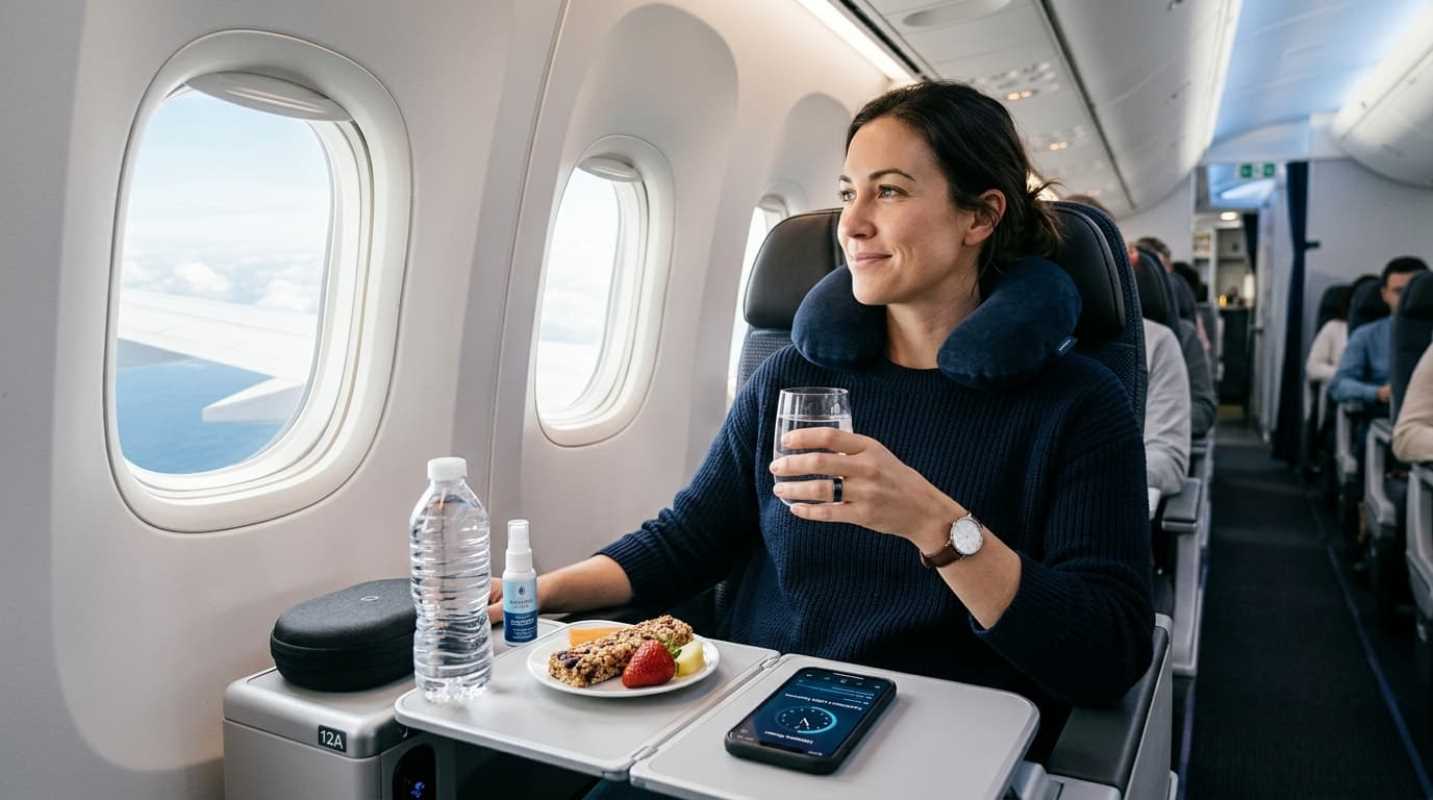
You step off a twelve-hour flight into the bright noon sun, but your brain feels like it's 4:00 AM in a fog-drenched basement. Your body is floating in a weird state of spatial confusion. Have you been there? That miserable feeling isn't in your head. It's a genuine biological mismatch. Tucked deep inside your brain sits a cluster of roughly 20,000 neurons called the suprachiasmatic nucleus. That tiny command center acts as your body's master clock, governing sleep, digestion, hormone production, and core body temperature.
When you cross multiple time zones in a metal tube, you teleport faster than your biology can adapt. Unassisted, your internal clock shifts by only about one hour per day. Fly across six time zones, and you face almost a week of mental sludge and midnight stomach growls.
You don't have to accept that foggy transition as an inevitable tax on travel. Once you know how your master clock receives its cues, you can actively hack your recovery speed.
The Pre-Flight Approach: Priming Your Body for Arrival
Most travelers wait until they land in a new hotel room to start dealing with jet lag. That's a mistake. The battle begins three days before you even zip your suitcase closed.
By shifting your habits slightly ahead of time, you shorten the biological distance your body has to travel. Your exact approach depends on which direction you're flying.
• Eastbound trips (Phase Advance): Flying east shrinks your day, which is harder on your body. Shift your sleep and wake schedule 30 to 60 minutes earlier each night for three days before departure. Seek bright morning light right when you wake up, and put on blue-light blocking glasses in the late evening.
• Westbound trips (Phase Delay): Flying west stretches your day, which most people find easier. Push your bedtime 30 to 60 minutes later each night for three days. Get plenty of bright light in the late afternoon, and avoid bright light early in the morning.
• Metabolic priming: Drink twice as much water as you think you need during the 48 hours before your flight. Skip heavy, processed pre-flight airport meals, because a sluggish digestive system makes circadian shifting much harder.
Mastering Light Exposure Timing: The Ultimate Tool
Light is the single most powerful tool you have for resetting your biological clock. Sunlight hits specialized cells in your eyes that send an immediate signal to your brain, halting melatonin production and setting your daily timer.
Getting sunlight at the wrong time can actually push your clock in the wrong direction. Following a precise light timing schedule reduces severe jet lag symptoms in over 96 percent of travelers.¹
To get the timing right, you need to estimate your Temperature Minimum (T_{min}). This is the exact moment when your core body temperature hits its lowest point in a 24-hour cycle. It usually occurs about two hours before your normal natural wake-up time. If you normally wake at 7:00 AM, your T_{min} is roughly 5:00 AM.
Here is how you use that number:
• To shift your clock earlier (Eastbound): Expose your eyes to bright light in the two to four hours after your T_{min}. Morning sunlight after this threshold tricks your brain into thinking the day started sooner.
• To shift your clock later (Westbound): Seek bright light in the four to six hours before your T_{min}. Late afternoon or evening light convinces your brain that the day is stretching on.
• Outdoor light vs windows: Get outside without sunglasses for 10 to 20 minutes. Window glass filters out needed blue-green wavelengths, requiring almost 50 times longer exposure to trigger the same shift.²
Researchers at Stanford even found that brief flashes of light during sleep can shift your clock through closed eyelids, proving just how sensitive these biological pathways are.³
In-Flight Tactics: Managing Energy and Hydration
The moment you step onto the plane, set your watch to your destination's time zone. Stop thinking about what time it is back home.
Airplanes are high-altitude dehydration chambers. Cabin air has minimal humidity, which accelerates physical exhaustion and makes your head throb. Drink a full glass of water for every hour you are in the air.
Skip the free cabin wine and late-night coffee. Alcohol destroys deep sleep architecture and dehydrates you faster, while caffeine consumed at the wrong time locks your brain into your home time zone.
Your digestive tract contains its own peripheral biological clocks. When you eat a heavy meal during what your gut thinks is 3:00 AM, digestive enzymes are at rock bottom. This creates systemic inflammation and bloating. Try fasting on long flights, or eat strictly according to meal times at your destination.
Post-Flight Protocol: Synchronizing to Your New Reality
When you land, resist the urge to drop your bags and take a four-hour afternoon nap. A long nap in the middle of the day wipes out your sleep drive and restarts the cycle of misery.
If you must rest, take a brief 20-minute power nap before 3:00 PM local time. Otherwise, power through until a normal local bedtime.
Use these steps during your first 48 hours on the ground:
• Get immediate sunlight: Step outdoors as soon as you wake up at your destination. Let direct sunlight hit your eyes to anchor your master clock to local time.
• Eat a high-protein breakfast: A protein-focused meal upon waking signals to your liver and gut that a new active day has begun.
• Move your body: Do a light workout or brisk outdoor walk in the morning. Physical movement raises core body temperature, reinforcing your new circadian schedule.
• Smart melatonin use: Ignore the common advice to take giant 5-milligram or 10-milligram melatonin doses. Take a micro-dose of 0.5 to 1.5 milligrams about 30 to 60 minutes before local bedtime when traveling east to signal that night has arrived.
Travel Smarter, Not Harder
Jet lag doesn't have to ruin the first three or four days of your vacation or business trip. Your biological clock is remarkably responsive once you know how to talk to it.
By adjusting your light exposure, timing your meals, and shifting your sleep window a few days early, you take full control of your recovery. Next time you pack your bags, use these light and timing approaches. You'll hit the ground running while everyone else is still waiting for their brains to wake up.
Sources:
1. Forbes
https://www.forbes.com/sites/emesemaczko/2026/04/27/what-nasa-linked-circadian-science-can-teach-travelers-about-beating-jet-lag/
2. Huberman Lab
https://www.hubermanlab.com/newsletter/defeat-jet-lag
3. Stanford Medicine
https://med.stanford.edu/news/all-news/2016/02/study-finds-possible-new-jet-lag-treatment.html
*This article on legitlevel is for informational and educational purposes only. Readers are encouraged to consult qualified professionals and verify details with official sources before making decisions. This content does not constitute professional advice.*